Ask any hospital administrator who has been through an NABH accreditation cycle, and they will tell you the same thing. It is not the clinical standards that cause the most stress. It is the paperwork. Documentation trails, audit logs, incident records, and process checklists that need to be accurate, complete, and ready to produce at a moment’s notice.
For hospitals still relying on manual registers and scattered files, this becomes a scramble every time an assessment approaches. For hospitals running on the right software, it becomes something far less dramatic, a routine part of daily operations that is already in order well before the assessors walk in.
Why NABH Compliance Is Harder Than It Looks
NABH accreditation is built around consistency. Assessors are not just checking whether a hospital follows good practices once in a while. They are checking whether those practices happen the same way, every time, across every department and every shift.
This is where manual systems tend to break down. A protocol followed correctly by one team on a Monday morning might be followed slightly differently by another team during a busy Saturday night. Without a system enforcing consistency, gaps appear quietly, and they are usually the gaps that show up during an audit.
Common challenges hospitals face include:
- Incomplete or inconsistent patient documentation
- Missing audit trails for critical processes
- Difficulty tracking incident reports across departments
- Manual checklists that are easy to skip during busy periods
- No centralised view of compliance status across the hospital
How the Right Software Changes This
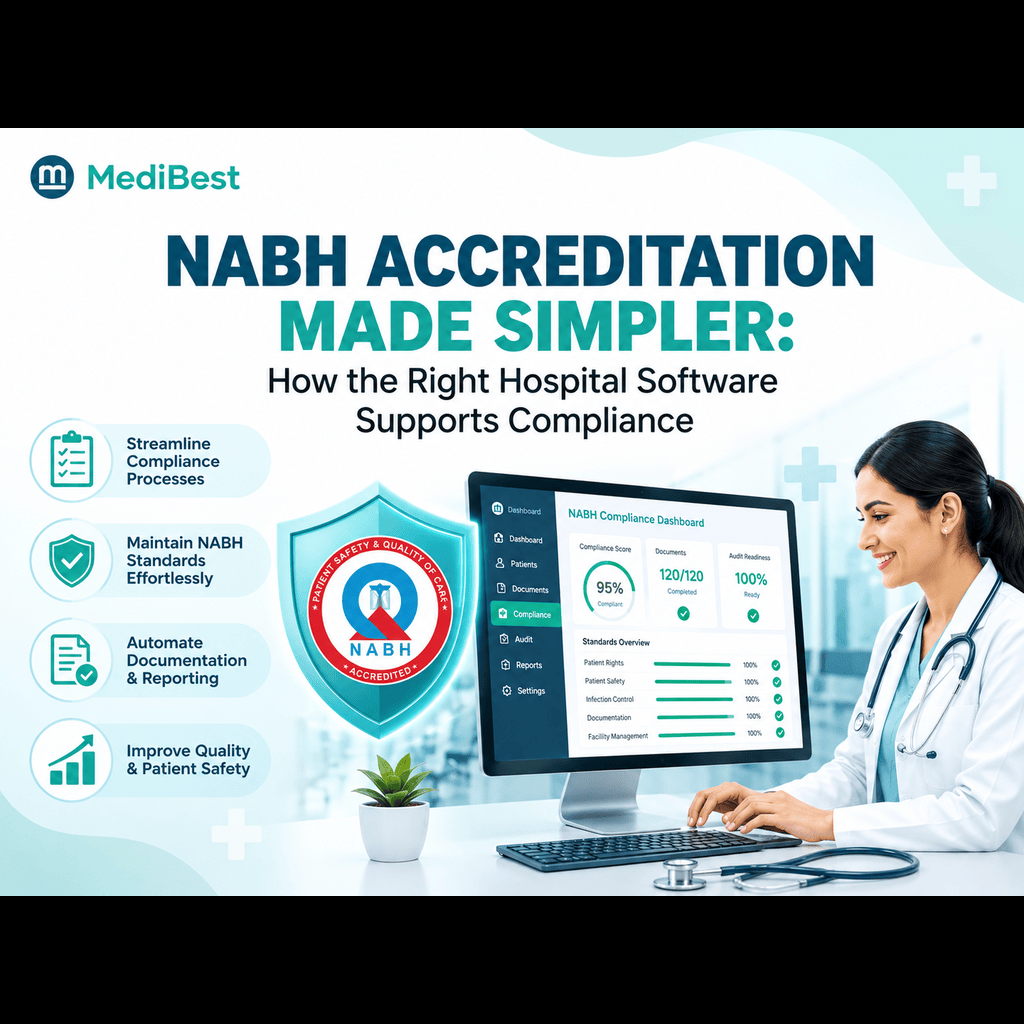
A good hospital administration software system does not just digitise paperwork. It builds compliance directly into daily workflows, so staff are following the correct process simply by using the system as intended, without needing to remember every rule separately.
Here is what this looks like in practice:
- Standardised workflows: Every department follows the same documented process, regardless of shift or staff member
- Automatic audit trails: Every action, from patient admission to discharge, is logged and timestamped without manual effort
- Real time incident tracking: Issues are recorded and routed to the right team immediately, rather than being noted on paper and forgotten
- Checklist enforcement: Critical steps cannot be skipped, since the system prompts staff at each stage
- Centralised reporting: Compliance status across departments is visible in one place, instead of being pieced together manually before an audit
This kind of structure is exactly what NABH assessors look for, evidence that good practices are built into how the hospital actually runs, not just written down in a policy document somewhere.
Quality and Risk Go Hand in Hand
NABH standards cover both clinical quality and patient safety, which means compliance cannot rely on a single tool doing everything. Hospital quality management software handles one half of this picture, tracking whether processes meet defined standards, from infection control protocols to medication administration steps, and flagging deviations before they turn into recurring problems.
The other half comes from risk management, which focuses on identifying and reducing the chances of something going wrong before it happens. A well built hospital risk management software module handles this through incident tracking, near miss reporting, and proactive alerts, giving hospital leadership visibility into problems while they are still small and manageable.
When these two functions are connected within a single hospital management system, patterns become much easier to spot. A recurring near miss in one department, for example, can be flagged and addressed before it becomes a serious incident, which is exactly the kind of proactive practice NABH accreditation rewards.
This connects closely to the broader picture of how technology supports compliance, something we explored in more detail in our earlier piece on how hospital management software helps hospitals comply with regulations, which covers the regulatory side beyond NABH specifically.
What This Means for Hospital Leadership
Beyond passing an audit, this kind of software brings real operational benefits that leadership tends to appreciate long after the accreditation certificate is on the wall.
- Less time spent preparing documentation manually before assessments
- Fewer surprises during audits, since gaps are caught early through daily use
- Better visibility into which departments need additional support
- Stronger patient safety outcomes as a natural result of consistent processes
- A system that supports reaccreditation cycles, not just the first one
Medibest has supported hospitals through this exact transition, moving compliance from a stressful once in a few years event to something that simply reflects how the hospital already operates day to day.
Frequently Asked Questions
1. What is NABH accreditation and why does it matter?
NABH, or National Accreditation Board for Hospitals and Healthcare Providers, sets quality and safety standards for Indian healthcare facilities. Accreditation signals to patients, insurers, and regulators that a hospital consistently follows recognised best practices.
2. Can hospital software actually help with NABH compliance?
Yes. Software that enforces standardised workflows, tracks audit trails automatically, and centralises documentation makes it significantly easier to demonstrate the consistency NABH assessors look for, rather than trying to prove it retroactively with scattered records.
3. Is quality management software the same as risk management software?
They are closely related but focus on different things. Quality management tracks whether processes meet defined standards, while risk management focuses on identifying and reducing potential safety issues before they occur. Together, they cover both sides of NABH requirements.
4. How long does it usually take to prepare for NABH accreditation with the right software?
This varies by hospital size and current documentation maturity, but hospitals using integrated compliance software generally spend far less time in dedicated preparation, since much of the required evidence is already being generated through daily operations.
5. Does this software help with reaccreditation as well as the first assessment?
Yes, and this is often where it delivers the most value, since ongoing consistency is easier to maintain and demonstrate when the system is already embedded into daily hospital workflows rather than reintroduced before each cycle.
Ready to Simplify Your Hospital’s Compliance Journey
If NABH preparation currently feels like a last minute scramble rather than a routine part of daily operations, it may be time to look at how your current systems are supporting, or failing to support, compliance. Get in touch with Medibest to discuss how the right hospital software can make your next accreditation cycle far less stressful for your entire team.