Hospitals should evaluate hospital management software support by checking response time guarantees, support availability hours, escalation processes, and whether a dedicated contact exists for critical issues, not just whether a support team exists on paper. Every vendor claims to offer good support. Very few can explain exactly what happens when a billing module goes down at 2 AM or when a critical patient record fails to load during a busy shift. That gap between claimed support and actual support is where hospitals get hurt after the contract is already signed.
Software features get most of the attention during a purchase decision. Support gets a passing mention, usually near the end of a sales call, and rarely gets the scrutiny it deserves. That’s backwards. A hospital runs around the clock, and even a short software outage can affect patient safety, billing accuracy, and staff confidence in the system. Evaluating support properly before buying isn’t a formality, it’s one of the most important parts of choosing hospital management system software.
Why Support Quality Matters More in Healthcare Than Almost Any Other Industry
A retail business can survive a software glitch for a few hours. A hospital cannot afford the same tolerance. When systems go down in a healthcare setting, the consequences show up immediately, in delayed treatments, billing errors, or staff reverting to manual processes that increase the risk of mistakes.
- Downtime during patient admission can delay treatment starts
- Billing system failures create backlogs that are painful to reconcile later
- Staff who lose trust in the system after repeated outages start working around it, defeating the purpose of the software entirely
This is exactly why support evaluation deserves the same rigor as feature comparison, not less.
Ask About Response Time Commitments, Not Just Availability
“24/7 support” sounds reassuring until you realize it doesn’t tell you how fast anyone actually responds. Push vendors for specifics.
- What’s the guaranteed response time for a critical issue versus a minor one?
- Is there a written SLA (service level agreement), or is this a verbal promise?
- Does response time mean someone acknowledges the ticket, or someone actually starts resolving it?
- Are these commitments the same for every client, or do they vary by contract tier?
A vendor offering healthcare management software without a clear, written response time commitment is asking you to trust their word alone, which isn’t something to build a hospital’s daily operations on.
Understand the Escalation Path Before You Need It
Every support system eventually hits an issue the first-line team can’t solve. What happens next matters just as much as the initial response.
- Who handles the ticket if the first support agent can’t resolve it?
- Is there a technical escalation team, or does everything route back to the same queue?
- How long before an unresolved issue automatically escalates?
- Is there a named account manager for larger hospital clients, or does every issue go through a general ticketing system?
Hospitals that skip this question often discover the escalation path only during an actual crisis, which is the worst possible time to find out it doesn’t exist.
Check How Support Handles Different Departments’ Needs
Not every support issue looks the same. A billing glitch, a lab integration failure, and a login issue for a doctor mid-shift all require different levels of urgency and different technical knowledge.
| Issue Type | What Good Support Looks Like |
| Critical clinical system failure | Immediate response, dedicated technical team |
| Billing or claims error | Fast turnaround, clear communication on fix timeline |
| Minor UI or login issue | Same-day resolution, self-service option available |
| Feature request or customization | Structured intake process with realistic timelines |
A software for healthcare management platform with a mature support structure will have distinct pathways for these categories instead of funneling everything into one generic queue.
Ask for Real Examples, Not Just Policy Statements
Any vendor can describe their support process in ideal terms. The more useful question is how that process actually performed during a real problem.
- Ask for a specific example of a major issue they resolved for another hospital client
- Ask how long it took from report to resolution
- Ask what changed in their process afterward to prevent recurrence
- Request references from existing clients specifically about support experience, not just software features
Vendors who can answer this concretely and quickly usually have support processes that hold up under pressure. Vague or rehearsed answers are a signal worth taking seriously.
Confirm What’s Included Versus What Costs Extra
Support terms often look generous in a sales pitch and shrink considerably once the contract details come out. Before signing, get clarity on:
- Is standard support included in the base price, or is it a separate paid tier?
- Are software updates and patches part of support, or billed separately?
- Does on-site support cost extra, and how quickly can it be arranged if needed?
- What happens to support quality or pricing after the first year?
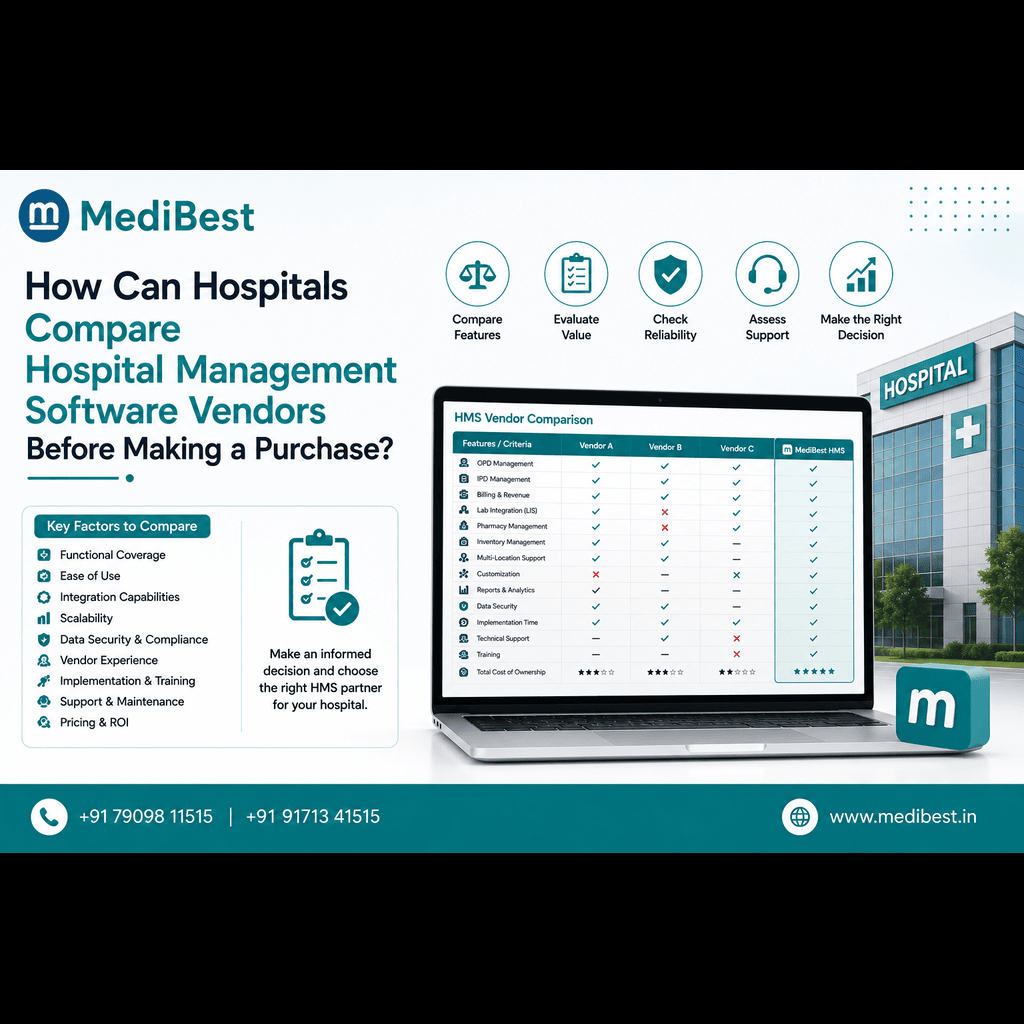
This is closely tied to the total cost conversation covered in our guide on comparing hospital management software vendors, since support terms are often where the real cost of a contract hides.
Evaluate Support During the Demo, Not After Signing
The best time to test support responsiveness is before you’re locked into a contract. During evaluation, hospitals can:
- Contact the support line directly, outside of the sales process, and time the response
- Ask technical questions to a support agent rather than a salesperson
- Request a trial period specifically to observe support quality, not just software features
- Check independent reviews focused on post-sale support experience, not just the platform itself
A vendor confident in their support quality won’t hesitate to let you test it early.
Support Evaluation Checklist at a Glance
- Written SLA with specific response time commitments
- Clear escalation path with named contacts for critical issues
- Category-specific support for clinical, billing, and technical issues
- Verifiable examples of past issue resolution
- Transparent pricing on what’s included versus billed separately
- Ability to test support responsiveness before signing
Frequently Asked Questions
1. What is a reasonable response time for critical hospital software issues?
For critical issues affecting patient care or billing operations, a response within 15 to 30 minutes is a reasonable expectation, with active resolution work beginning shortly after acknowledgment.
2. Should hospitals get support commitments in writing?
Yes. A verbal assurance during a sales call carries no weight once the software is live. A written SLA with specific response times and escalation steps protects the hospital if support falls short later.
3. Is 24/7 support always necessary for hospital management software?
For hospitals running round-the-clock operations, yes. Even smaller facilities benefit from at least extended-hours support, since patient care doesn’t follow a nine-to-five schedule.
4. How can hospitals test support quality before signing a contract?
Contact the support line directly during the evaluation period, ask technical questions outside the sales process, and request a trial period specifically to observe how quickly and clearly issues get resolved.
5. Does Medibest offer a dedicated support structure for hospital clients?
Yes. Medibest provides structured support for its hospital management software with clear escalation paths, so hospitals aren’t left waiting during critical issues.
Choosing Support You Can Actually Rely On
Support quality often decides whether a hospital’s software investment pays off or becomes a daily frustration. Testing response times, understanding escalation paths, and getting commitments in writing before signing protects a hospital from discovering these gaps during an actual emergency. Medibest builds its support structure around the reality that hospitals can’t afford downtime, with clear response commitments and a dedicated escalation path for every client.
Contact Medibest Techserv LLP, for details on our support structure and response commitments, get in touch with our team today.